Where to Keep Important Documents: Safe, Bank Box or Attorney
By the Emergency Binder Now team · Updated · 14 min read
In this guide
- The question that sorts almost everything
- A fire-resistant home safe
- The bank safe deposit box
- With the attorney or the probate court
- Copies already in the right hands
- Scans and a password manager
- What goes where: originals and copies by document
- Who needs to know, and how they get in
- Mistakes that cause the most trouble
- Frequently asked questions
- Putting the locations on paper
Keep important documents in more than one place, sorted by how fast someone will need them. Originals that might be needed at short notice, like powers of attorney and health care directives, belong in a fire-resistant home safe or file that a trusted person can open. Originals nobody needs in a hurry, like deeds and birth certificates, can go in a bank safe deposit box. The original will often stays with the drafting attorney or, in some states, on deposit with the probate court, while copies and encrypted scans go to the people who would act on them.
The part that tends to get skipped is writing down where each thing is and checking that the right person can actually get in.
This article is about where. If you're still working out what to gather, start with our list of important documents for aging parents and come back here.
The question that sorts almost everything
Before comparing safes and bank boxes, ask one question about each document: who would need this, and how fast?
A health care proxy might be needed at 2 a.m. on a Saturday in an emergency room. A deed might not be needed for years. They shouldn't share a location just because both are "important."
- Needed within hours: POLST or out-of-hospital DNR, health care proxy, living will, medication list, insurance cards. At home, reachable, with copies already with the people who'd use them.
- Needed within days or weeks: financial power of attorney, the will, burial wishes, trust documents, account list. Somewhere a named person can open without a court order.
- Rarely needed, hard to replace: deeds, vehicle titles, birth and marriage certificates, military discharge papers, paper savings bonds. Somewhere very secure and slightly inconvenient is fine.
A fire-resistant home safe
The National Institute on Aging suggests keeping important papers in one place and, for added security, a fireproof and waterproof safe. But "fireproof" on a store shelf can mean a lot of things.
What the fire rating on the label means
The common American standard is UL 72, Tests for Fire Resistance of Record Protection Equipment. Its published scope sorts equipment into classes by the highest temperature allowed inside during the test, and each class matches a type of record:
| Class on the label | Meant to protect |
|---|---|
| Class 350 | Paper records |
| Class 150 | Paper plus non-paper records like magnetic tape and photographic records |
| Class 125 | All of that, plus flexible computer disks |
The number is the Fahrenheit temperature the inside must stay under during the test. The two lower classes also cap humidity inside. The standard covers "various durations of fire exposure," which is why a label usually pairs the class with a time, such as one hour.
What that means in practice:
- Class 350 is the paper rating. For a will, POA, deeds and certificates, look for it plus a time rating.
- A paper rating isn't meant for a thumb drive or photo negatives. Keep the backup drive elsewhere, or use a media-rated safe or insert. UL's scope also notes that the tests themselves don't use non-paper records as contents.
- Some safes also pass an impact test. Equipment sold as impact resistant goes through a fire and impact test that includes a 30-foot fall. Worth a look for a safe on an upper floor.
- Look for who did the testing. A UL 72 class from an independent lab tells you far more than "fire resistant" with no class, no time and no tester named.
What the rating doesn't cover
The UL 72 scope says burglary resistance is not part of the standard, lock or no lock. It also says the test is not meant to show whether the safe is fit for use after a fire. If your parent's safe has been through one, don't count on it for the next; ask the manufacturer.
And UL 72 is a fire test. A water-resistance claim is separate and needs its own reading, which matters in a basement, where a burst pipe or a flood is a real risk. The FDIC suggests a cheap extra layer: resealable, water-safe plastic bags or containers inside whatever box you use.
Bolt it down, and plan the way in
The FDIC is blunt that a burglar can more easily beat a home safe than a bank box. Small fire safes are light enough to carry out the door, and the Pasadena Police Department has advised residents to bolt safes down to a concrete floor or other immovable surface after officers saw safes of all sizes hauled away by thieves. Keep it away from water heaters and bathroom plumbing, and low enough that your parent can open it without a step stool.
Then decide who else can open it:
- Where the key or combination is written, and who knows. Not taped to the safe.
- Whether there's a backup key, and where it lives. With the financial agent is a common choice.
- If it has a keypad, what happens when the battery dies, and where any override key is.
The home safe is the natural place for originals of the financial power of attorney, health care proxy and living will, because people need those fast and banks close.
The bank safe deposit box
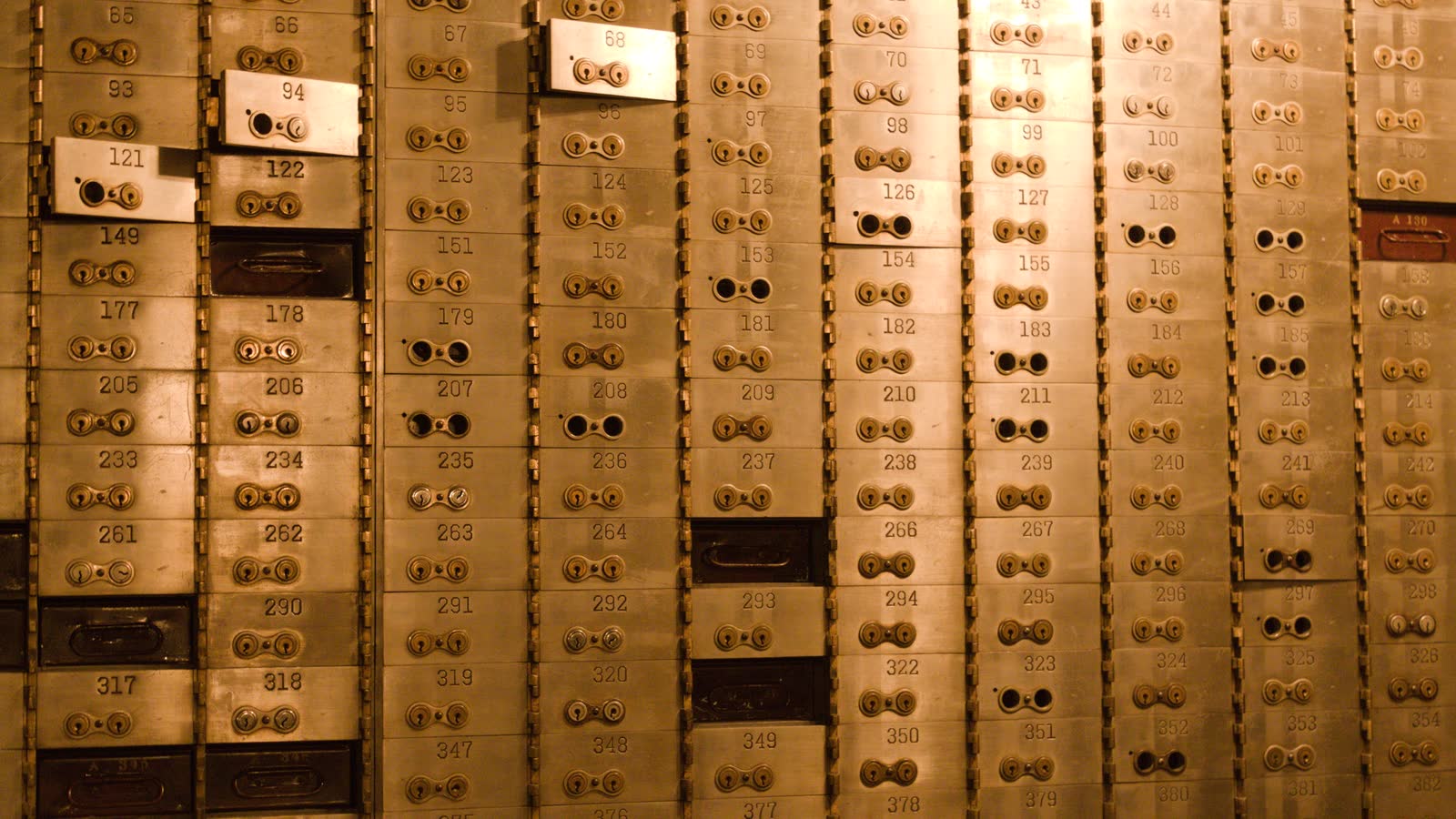
A safe deposit box is good at keeping hard-to-replace things secure and bad at what families need most in a crisis: quick access.
It isn't insured the way people assume
The FDIC is direct. A safe deposit box is not a deposit account but storage space, so the contents aren't covered by FDIC insurance if damaged or stolen, and banks generally don't insure them either. For anything valuable, the FDIC suggests asking a homeowner's or renter's insurance agent about coverage. It also notes that no box or home safe is completely protected from theft, fire or flood, and that the rental agreement may limit what you can store, sometimes including cash.
Bank hours, and the incapacity gap
The FDIC warns against keeping anything you might need quickly, or when the bank is closed, in the box. Its examples are passports and originals of powers of attorney, financial and medical.
Picture it. Mom has a stroke on Friday night. Her health care proxy is in a box in her name only. Nobody can get in until the bank opens, and even then the bank may want to see the very document that's locked inside.
If your parent wants to keep the box, ask the bank on an ordinary day:
- Who is listed on the box now, and can a co-renter or agent be added?
- Will the bank accept your parent's financial power of attorney for box access, and does it want to review it in advance?
- Where are the keys, and what happens if one is lost?
The FDIC cautions that anyone your parent authorizes can remove things, and the bank likely won't be responsible, so add someone your parent truly trusts.
After a death, state law decides who gets in
Access to a box after the owner dies "depends on state law," an FDIC counsel told FDIC Consumer News, and those rules restrict who can enter and how.
Florida shows how specific it gets. When a box holder dies, the bank must let a person named in a court order or, without one, the spouse, a parent, an adult descendant, or someone named as personal representative in a copy of a purported will open and examine a box the person leased or co-leased, with a bank officer present. Under Florida Statutes section 655.935, only three kinds of papers can come out at that stage: a purported will (which goes to the probate court, not the family), a burial plot deed or burial instructions, and a life insurance policy (which goes to the named beneficiary).
Other states use different lists and procedures. Two lessons travel well:
- Burial wishes in the box can arrive too late. Someone has to prove the death, book a time and wait for a bank officer, while funerals are often planned within days.
- The will may not go to the family at all. In Florida the bank delivers it to the probate court in the county where the bank is, so the executor ends up dealing with the court, not the branch.
One more wrinkle: a box with no activity and no contact from the owner for long enough can be treated as abandoned and turned over to the state. The National Association of Unclaimed Property Administrators lists contents of safe deposit boxes among the common forms of unclaimed property. Note on your account list how the box rent is paid and which address the bank has on file.
What the box is good for
The FDIC's list: originals of birth certificates, property deeds, car titles and paper savings bonds, plus keepsakes, irreplaceable photos, and photos or video of the home's contents for insurance.
With the attorney or the probate court
For the original will, the two most common homes outside the house are the lawyer who drafted it and, where the state offers it, the probate court.
With the drafting attorney
Some estate planning attorneys keep clients' original wills in their office vault and give the client a copy. That works until the lawyer retires and nobody remembers who took over the practice. Write down the attorney's name, firm and phone, the date the will was signed, and whether the firm gave a written receipt. If it didn't, ask for a letter confirming they hold the original, and ask what happens to stored wills if the firm closes.
With the probate court
Some states let a living person deposit an original will with the court for safekeeping. Three examples, checked against the statute or court instructions:
- North Carolina requires the clerk of superior court in every county to keep a depository for wills. The testator, or their agent or attorney, can deposit it and withdraw it on written request. It stays private until the clerk receives proof of death.
- Ohio allows deposit with the probate court under R.C. 2107.07. Butler County's instructions for depositing an original will call for a sealed envelope with the testator's name, give the depositor a time-stamped certificate, and allow release during life only to the testator, someone they authorize in writing, or a probate court.
- Iowa directs the clerk to keep a file of wills deposited by living testators.
A court deposit answers "what if the lawyer's gone?" Either way, file the certificate or receipt at home and note it in the binder.
Copies already in the right hands
Some documents work best when copies are already in the right hands. The NIA advises giving copies of advance directives to the health care proxy, health care providers and lawyer, notes that some states run registries for quick access, and suggests that people who spend a lot of time in two states use each state's form and keep a copy in each place.
A sensible spread:
- Health care agent: health care proxy, living will, any POLST, medication list, HIPAA authorization.
- Financial agent: the financial POA, the account list, and where the originals are.
- Executor and successor trustee: a copy of the will and trust, or at least where the originals are and who drafted them.
- Primary care doctor: advance directives and any POLST, scanned into the chart.
The POLST breaks every rule about safes. National POLST tells families to keep it on the refrigerator, beside the bed or in the medicine cabinet, where emergency crews look, with a copy in the wallet near the ID. Photocopies are valid in almost all states. Our POLST guide covers the form itself.
Scans and a password manager
A scan lets a sibling three states away read the health care proxy to a hospital at midnight. It doesn't replace an original will, the one document where the original matters most.
- Scans go in an encrypted cloud folder shared with one or two people, with two-step login turned on.
- Logins go in a password manager. NIST says its experts highly recommend a password manager, and because one login protects everything inside, to choose one that supports multifactor authentication.
When a POA or directive is re-signed, replace the scan and mark the old one superseded. And plan access the same way as the safe: check whether your parent's password manager has an emergency access or sharing feature, and set it up while they can approve it.
What goes where: originals and copies by document
Here's how many families split it. If your parent's attorney recommends something different, go with the attorney.
| Document | Where the original lives | Who gets a copy or scan |
|---|---|---|
| POLST or out-of-hospital DNR | Fridge, bedside or medicine cabinet | Wallet copy; doctor; health care agent |
| Health care proxy and living will | Home safe or home file | Health care agent and backup; doctors; hospital; lawyer |
| HIPAA authorization | Home file | Each doctor's office; health care agent |
| Financial power of attorney | Home safe, or with the agent | Financial agent and backup; bank, reviewed in advance |
| Will | Drafting attorney, court deposit or home safe | Executor: a copy, or a note of where the original is |
| Trust | Home safe or attorney | Successor trustee |
| Burial wishes, prepaid funeral contract | Home safe or file, never only a bank box | Two or three family members; funeral home if prearranged |
| Deeds, vehicle titles | Safe deposit box or home safe | Scan |
| Birth, marriage, divorce, military papers | Safe deposit box or home safe | Scan |
| Paper savings bonds | Safe deposit box | Serial numbers listed in the binder |
| Passport, Social Security card | Home safe | Scan |
| Insurance cards | Wallet | Front-and-back copies in the binder |
| Recent tax returns and records | Home file | Scan |
| Safe combination, box key, attorney receipt | Home safe or with the financial agent | A note in the binder saying where, never the combination |
On tax papers, the IRS says to keep records generally for 3 years, longer in some situations, and records connected to property until the limitation period expires for the year the property is sold. The house purchase records can matter for decades.
Who needs to know, and how they get in
The NIA's checklist says to tell someone you know and trust, or a lawyer, where your papers are. Your parent can share where things are without sharing what they say.
For each person, write down what they need to know and how they physically get in:
- Health care agent: where the proxy, living will and POLST are, and confirmation that copies are already at the doctor's office.
- Financial agent: where the POA original is, the safe key or combination location, which bank and branch holds any box, and whether they're listed on it. The FDIC advises keeping the box number and bank name away from the key.
- Executor: who holds the original will, the attorney's contact details, any court deposit certificate, and where the burial wishes are.
- Whoever has digital access: how the cloud folder and password manager's emergency access work.
If siblings are dividing these roles, see our guide to sharing caregiving with siblings. If you're managing from far away, the long-distance caregiving checklist covers keeping a shared record.
Mistakes that cause the most trouble
- The only original POA in a box only your parent can open. The document that would get you in is inside.
- A keypad safe with a dead battery, and nobody who knows where the override key went.
- A paper-rated safe holding the photo backup drive. Class 350 is meant for paper.
- Two versions of the health care proxy in circulation. Collect or mark old copies when it's re-signed, and tell the doctor's office.
- "It's at the lawyer's," with no lawyer's name written down anywhere.
If there's no power of attorney at all, see what to do when a parent has no POA.
Frequently asked questions
Is a safe deposit box or a fireproof safe better for important documents?
Both, for different papers. The home safe suits documents needed quickly, like powers of attorney and health care directives; the bank box suits rarely needed papers like deeds and titles.
Are safe deposit boxes FDIC insured?
No. The FDIC insures deposit accounts, and a safe deposit box is storage space, so its contents aren't covered. Banks generally don't insure them either. Ask a homeowner's or renter's insurance agent about coverage.
Should a power of attorney go in a safe deposit box?
The FDIC advises against keeping originals of powers of attorney there, because they may be needed quickly or when the bank is closed. Keep the original at home or with the agent.
Where is the safest place to keep an original will?
It depends on the state. Common choices are the drafting attorney's vault, a home fire-resistant safe, or a court deposit where the state allows it, as North Carolina, Ohio and Iowa do. Ask an attorney in your parent's state, and make sure the executor knows exactly where it is.
Can I keep important documents in the cloud?
Encrypted scans with two-step login make a good backup, and a password manager is the right home for logins. A scan doesn't replace an original will or deed, so keep originals in physical storage.
Putting the locations on paper
The table above, a sit-down with your parent and one call to the bank will get most families there on their own. Buying the safe is the easy part. The written record of what lives where is what usually stalls.
If that record is the piece you'd like help with, Emergency Binder Now gets it from a guided interview of roughly 25 minutes. Your parent's printable binder notes, for each legal document, whether it exists and where the original is kept, and it adds a one-page emergency sheet for the ER and a short list of gaps. A sample binder shows what you'd get.
This article is general information, not legal or financial advice. Rules on safe deposit box access, will deposits and powers of attorney differ by state; check with an attorney in your parent's state.
This guide is general information to help families get organized. It isn't legal, medical or financial advice; for decisions about your parent, talk with their doctor, pharmacist or an attorney in their state.